
The Challenge
Middle and high school students in small towns and communities outside of major metropolitan areas face geographic and economic resource barriers that leave them with two choices: remain in the communities that shaped them or leave for the “big cities” to find opportunities to build a career, networks, or investment infrastructure that gives their dreams a chance to succeed (Gallup and Walton Family Foundation 2025 study).
If we want young people from small towns and rural communities to thrive, not just survive, then they need a tailored ecosystem of economic opportunity that expands their reality of what’s possible, connects them to the capital needed to pursue their dreams, and allows them to reject the belief that a life in their hometown means economic and professional sacrifice.
Our Model
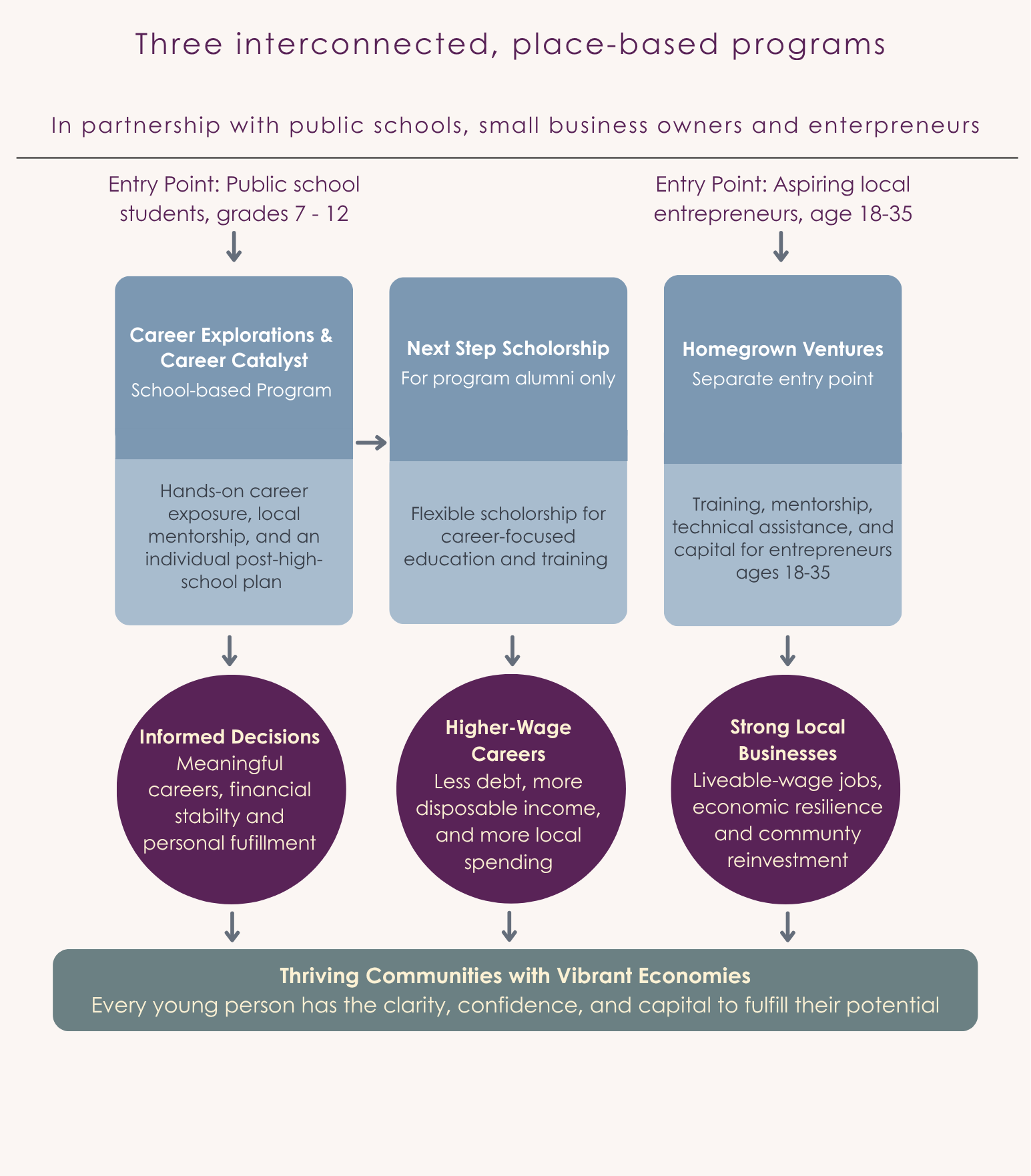
Three interconnected programs, one long term vision: economic opportunity for young people and the communities we serve.
An Ecosystem of Economic Opportunity
In partnership with public schools, young people and local entrepreneurs, Magnolia Project’s programs create a cycle of opportunity and community reinvestment. Students who explore careers become scholars and entrepreneurs. The businesses they join or launch become the next generation of mentors and scholarship sponsors.
Read diagram text
Title and partnership line Three interconnected, place-based programs
In partnership with public schools, small business owners and entrepreneurs
Entry points and programs Entry Point: Public school students, grades 7 - 12 points into Career Explorations & Career Catalyst.
Career Explorations & Career Catalyst
- School-based Program
- Hands-on career exposure, local mentorship, and an individual post-high-school plan
- Outcome: Informed Decisions — Meaningful careers, financial stability and personal fulfillment
A horizontal arrow connects Career Explorations & Career Catalyst to Next Step Scholarship.
Next Step Scholarship
- For program alumni only
- Flexible scholarship for career-focused education and training
- Outcome: Higher-Wage Careers — Less debt, more disposable income, and more local spending
Entry Point: Aspiring local entrepreneurs, age 18-35 separately points into Homegrown Ventures.
Homegrown Ventures
- Separate entry point
- Training, mentorship, technical assistance, and capital for entrepreneurs ages 18-35
- Outcome: Strong Local Businesses — Livable-wage jobs, economic resilience, and community reinvestment
There is no arrow making Homegrown Ventures a required next stage after scholarship. Each program's outcome connects to the shared bottom outcome.
Shared outcome Thriving Communities with Vibrant Economies
Every young person has the clarity, confidence, and capital to fulfill their potential
Page labels and links
The Challenge
Small towns
The ecosystem
Learning in our communities · Spring 2026
School Based ProgramsNext Step ScholarshipHomegrown Ventures
What Do We Mean by “Small Town”?
Magnolia Project is proud to serve small towns and communities outside of major metropolitan areas. For us, “small town” is not defined by population alone.
“Small town” describes communities outside major metropolitan centers (such as Los Angeles and New York) where economies are shaped by small, local businesses and employers and distinctive place-based industries, such as agriculture, tourism, food production and the skilled trades.
Our model and programs are specifically designed to overcome the geographic and resource constraints that can limit young people’s access to opportunities in communities outside of major cities.